 978 reviews


MINI Engine Mount Failure: What Bellingham Drivers Need to Know
Posted on May 12, 2026 by Carson Wileman
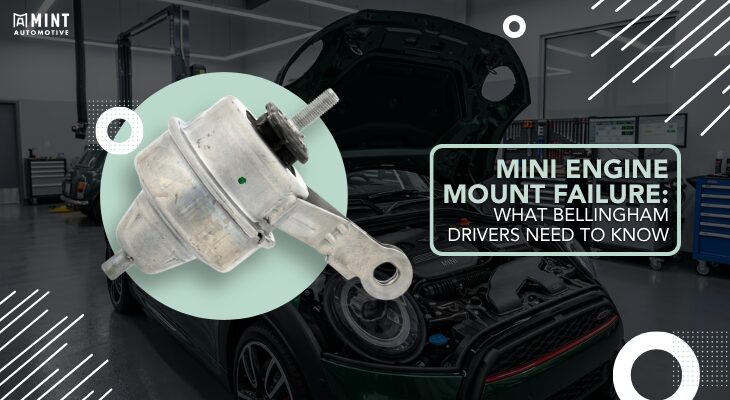
The MINI Cooper is built to deliver a spirited, connected driving experience, and engine mounts are a big part of making that possible. These components secure the engine to the chassis while absorbing and isolating the vibrations and torque forces generated during acceleration, braking, and cornering. On MINIs — particularly the first- and second-generation R-series models — engine mounts are a well-documented wear item that often fails earlier than owners expect. At Mint Automotive in Bellingham, our technicians handle MINI engine mount replacements regularly, and we want local drivers to understand the symptoms and consequences before a worn mount causes bigger problems down the road.
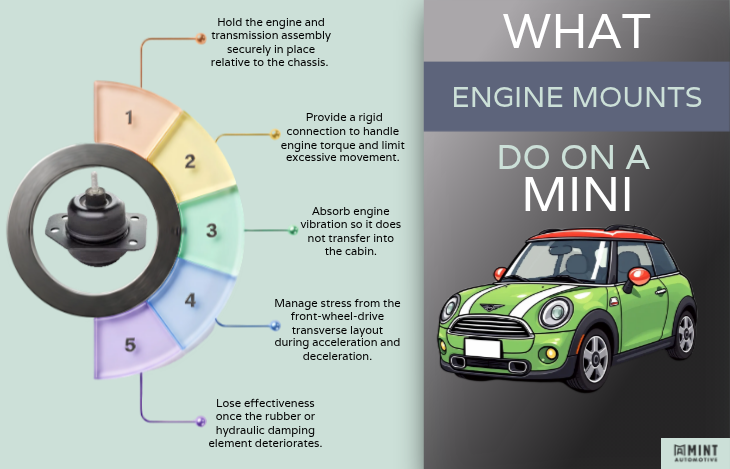
What Engine Mounts Do on a MINI
A typical MINI has two or three engine mounts — sometimes referred to as motor mounts — that hold the engine and transmission assembly in place relative to the chassis. On most MINI models, these are hydraulic or rubber-bushed mounts that are designed to do two opposing jobs simultaneously: provide a rigid enough connection to handle engine torque and prevent excessive movement, while also being flexible enough to absorb engine vibration so it doesn’t transfer into the cabin. The MINI’s front-wheel-drive transverse engine layout puts particular stress on the torque axis mounts during hard acceleration and deceleration, which is one reason these mounts wear faster in MINI Cooper S and JCW models with higher engine output. Once the mount’s rubber or hydraulic damping element deteriorates, it can no longer perform either function effectively.
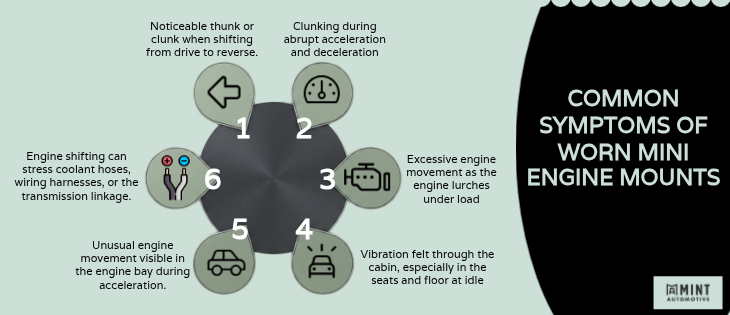
Common Symptoms of Worn MINI Engine Mounts
Failed or failing engine mounts on a MINI produce a distinct set of symptoms that are hard to miss once you know what to look for. The most common complaint is a noticeable thunk or clunk when shifting from drive to reverse, or during abrupt acceleration and deceleration — this is the engine physically lurching against its remaining constraint as the failed mount allows excessive movement. Vibration transmitted through the cabin, particularly noticeable in the seats and floor at idle or low RPM, is another indicator that the mount’s isolation properties have degraded. Some MINI owners also notice a change in handling feel or an unusual amount of engine movement visible in the engine bay when acceleration is applied. In more advanced cases, a failed mount can allow the engine to shift enough to stress coolant hoses, wiring harnesses, or the transmission linkage.
Why MINI Engine Mounts Fail in the Pacific Northwest
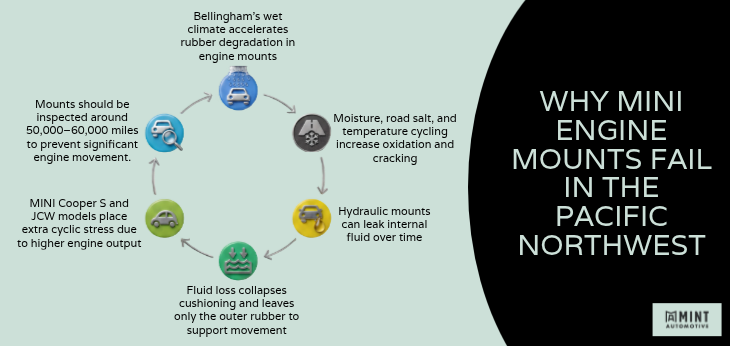
Bellingham’s wet climate accelerates rubber degradation in engine mounts. The moisture, road salt from winter conditions, and constant temperature cycling between warm and cold accelerate the oxidation and cracking of rubber mount components. Hydraulic mounts — which contain a fluid-filled chamber for enhanced vibration damping — can also leak their internal fluid over time, collapsing the mount’s cushioning capacity and leaving only the outer rubber structure to do the work. MINI Cooper S and JCW variants with their higher output engines place additional cyclic stress on mounts during spirited driving, shortening service life compared to base Cooper models. Most MINI mounts should be inspected around 50,000–60,000 miles and replaced before they reach the point of allowing significant engine movement.
How Mint Automotive Diagnoses and Replaces Engine Mounts
Our Bellingham MINI technicians diagnose engine mount condition both visually and through physical inspection. We look for cracks, oil contamination, and visible collapse of the rubber or hydraulic element. We also manually test for excessive engine movement under load conditions. When mounts need replacement, we use quality components — OEM or equivalent — and replace mounts in sets where practical, since if one has failed, the others are often not far behind. The repair is completed on a lift with the engine supported, and we perform a thorough inspection of surrounding components, including drive axles, coolant hoses, and wiring harnesses, to ensure nothing was stressed or damaged by the failed mount. Contact us to get started.
Book Your MINI Inspection at Mint Automotive in Bellingham
If your MINI is clunking, vibrating, or feeling rougher than usual, don’t ignore it. At Mint Automotive in Bellingham, our MINI-experienced technicians can diagnose engine mount wear quickly and get your car back to its smooth, responsive best. Call us at (360) 733-2721 or visit us at 1814 Ellis Street, Bellingham, WA 98225 to schedule your service.
Frequently Asked Questions
Q: How urgent is it to replace worn engine mounts on a MINI?
A: It’s worth addressing promptly. Severely failed mounts allow enough engine movement to damage hoses, wiring, and the transmission linkage, turning a modest repair into a much larger one.
Q: Can I drive my MINI with a failed engine mount?
A: Short distances may be possible, but we don’t recommend it. The excessive engine movement stresses adjacent components and the symptoms will continue to worsen.
Q: How long does a MINI engine mount replacement take?
A: Most MINI engine mount jobs take between one and three hours depending on which mount is being replaced and whether the job involves hydraulic or rubber mount designs.
Q: Do both engine mounts need to be replaced at the same time?
A: Not always, but we often recommend it if both mounts have similar mileage. Replacing only the failed one while leaving a worn companion mount typically means a return visit within a short period.