 978 reviews


VW & Audi Ignition Coil Misfires: The Cold-Morning Warning Signs in Bellingham
Posted on August 18, 2026 by Carson Wileman
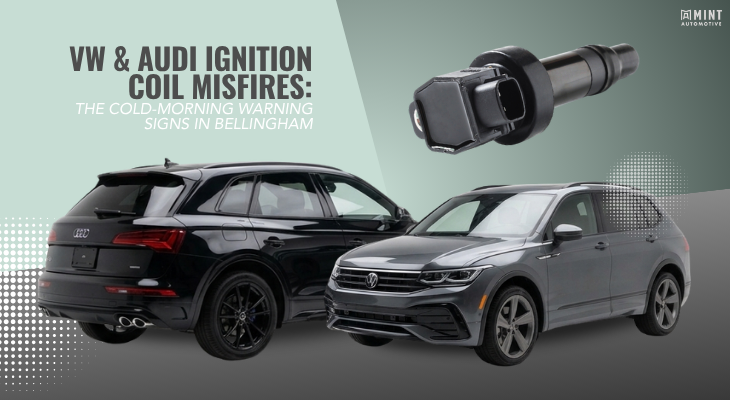
You are halfway up the Mount Baker Highway on a damp 50-degree morning. The GTI stumbles and the check engine light starts flashing. Back off and it smooths out. A flashing light means one cylinder is dumping raw fuel into the exhaust.
Wasted fuel piles up fast, and the U.S. Department of Energy estimates that hard stop-and-go driving alone cuts gas mileage by 10% to 40% before a misfiring cylinder adds its own loss.
Quick Summary: Key Takeaways
- A flashing light means stop driving: Steady is a fault, flashing is an active misfire eating your converter.
- Coils and plugs go together: On the 2.0T EA888 we replace all four coils with fresh plugs.
- Plugs are a 40,000-mile item: Worn plugs raise coil voltage, and that is what burns coils out.
- Heat cycles do the damage: A summer of underhood heat hardens the boots, and the first cold, wet mornings expose the arcing.
- Codes P0301 through P0304 name the cylinder: The failed part is not always in that cylinder.
Coil-on-plug ignition gives every cylinder its own failure point
Your VW or Audi runs one pencil coil per cylinder, sitting directly on the spark plug, with no distributor, no plug wires and no shared parts anywhere in the system. Each coil works alone.
That design stays reliable until the internal windings break down or the rubber boot cracks, at which point the spark takes the easy path to ground and the cylinder stops making power. Turbo engines suffer sooner because cylinder pressure demands higher voltage.
The engines here are familiar. EA888 2.0T in the GTI, Jetta, Tiguan, A3, A4 and Q5, the 1.4T EA211, and the 3.0T V6, all sharing the same basic coil design.
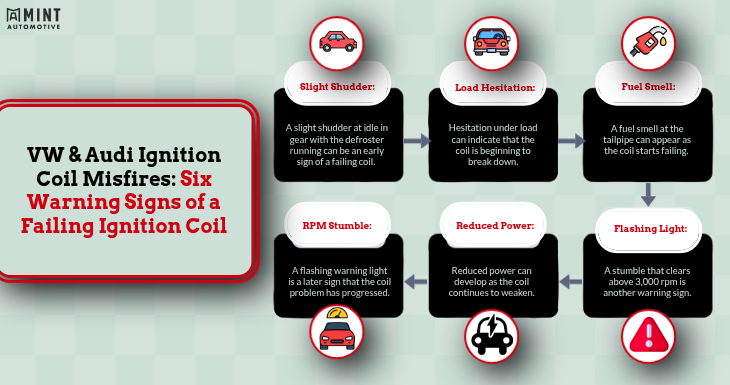
Six warning signs show up before a coil quits completely
The earliest sign is a slight shudder at idle in gear with the defroster running, and a stoplight on Guide Meridian is where most owners first feel it. Then it spreads.
Hesitation under load, a fuel smell at the tailpipe, a stumble that clears above 3,000 rpm, reduced power, and finally the flashing light round out the list. Cold starts deserve attention too.
A breaking-down coil gives a rough first thirty seconds on a cool morning, then behaves. Do not wait for the flash, because a stored P0302 lets us fix a ninety-dollar part instead of a converter. Chuckanut Drive climbs kill converters.
Worn plugs, oil in the boot and heat cycles kill coils early
Coils rarely fail on their own, and the usual cause is a spark plug left in too long, because as the electrode wears the gap widens and the coil strains harder. That extra voltage cooks it.
Oil is the second cause, because a weeping valve cover gasket fills the plug wells and lets spark track along the outside of the insulator instead of jumping the gap. Replace only the coil and the misfire returns within weeks. Fix the leak too.
Heat finishes the job. Every start cycles the coil between ambient and roughly 250 degrees, and after nine years the potting compound inside develops cracks. A summer of that pushes it over the edge.
A misfire left alone destroys parts that cost far more than a coil
Unburned fuel goes into the exhaust and ignites inside the catalytic converter, where substrate temperature climbs past anything the ceramic honeycomb was built to survive. Then it melts.
Once that happens you are buying a converter, and on an Audi 3.0T with two of them the bill runs into thousands for a failure that started as one coil. We have seen it enough around Bellingham to be blunt.
Fuel dilution is quieter. Raw gasoline washes past the rings into the crankcase, thins the oil and reduces protection for the turbocharger bearings. Oil analysis shows it long before a bearing fails.
Our Bellingham diagnosis confirms the cylinder before we sell parts
We pull freeze-frame data and misfire counters with factory-level software rather than a generic code reader, which shows exactly which cylinder misses, at what rpm and under what load. Then we test.
A coil swap between cylinders, a plug inspection for oil and electrode wear, and a fuel trim check for vacuum leaks tell us whether ignition is really the problem. If the numbers look mechanical we run compression and leak-down.
A burnt valve reads as a misfire. Then we fix it with OEM coils, correct-gap plugs and a valve cover gasket when oil sits in the wells. Our Ellis Street shop has done German ignition work here for over twenty years.
Frequently Asked Questions
Q: How do I know if my VW ignition coil is bad?
A: Several ways. Look for rough idle, hesitation under acceleration, a cylinder-specific code like P0303, and a check engine light. A flashing light confirms an active misfire, and if the stumble shows up mainly on cold starts or under boost then ignition is our first stop.
Q: Should I replace all four ignition coils at once on a 2.0T?
A: Usually yes. The coils are the same age and have seen identical heat cycles, so replacing one on a 90,000-mile engine often means coming back within a year. Labor is nearly the same for one or four.
Q: Can I keep driving with a misfire in my Audi?
A: Not with a flashing light. Fuel is reaching the catalytic converter unburned, and that can ruin it within miles. If the light is steady and the car drives acceptably, take it straight to a shop.
Q: How often should VW and Audi spark plugs be replaced?
A: We recommend 40,000 miles on most turbocharged 2.0T engines, which is shorter than some published intervals. Plugs are cheap. Fresh ones with the correct gap are the best thing you can do for coil life.
Get the misfire diagnosed before your converter pays for it
Act now. A rough idle or flashing light deserves attention this week. Contact our Bellingham shop with the code you see and how the car behaves cold versus warm.
Hours: Mon-Fri 8:00 AM to 5:00 PM
Website: mintautomotive.com