
 978 reviews


Your Volkswagen’s Automatic Wipers Stopped Working, and So Did the Automatic Headlights
Posted on November 25, 2026 by Carson Wileman
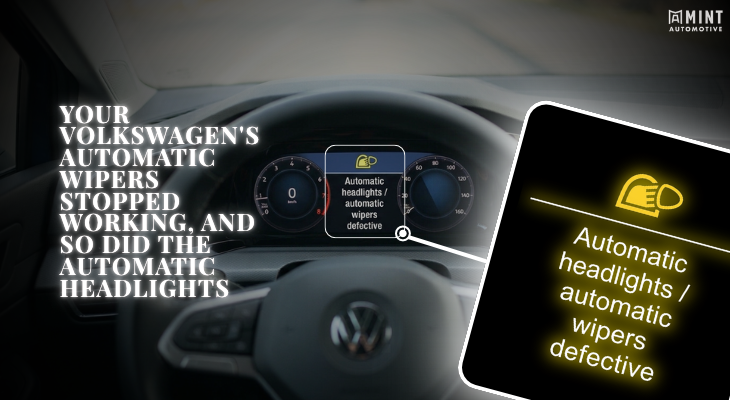
Owners almost always report these as two separate faults, and they are usually the same one. The wiper stalk in Auto and the headlight switch in Auto both take their orders from a single component glued to the inside of the windshield, roughly behind the mirror, and when it stops reporting, both features quietly revert to doing nothing.
That matters more here than it would in Phoenix. The Federal Highway Administration puts over 77 percent of weather-related crashes in rain or mist conditions, averaged across 2019 to 2023, and Whatcom County delivers rain and mist in volume from now until spring.
Quick Summary: Key Takeaways
- One sensor, two jobs: a rain-light sensor drives both the Auto wipers and the Auto headlights on most VW models.
- Check the manual positions first: if wipers and lights work when switched on by hand, the sensor circuit is the suspect.
- The gel pad is a common failure: the clear adhesive between sensor and glass clouds or lifts, and the optics stop reading the glass.
- Windshield work is a frequent trigger: a sensor that was removed and refitted badly will never work right.
Start by ruling out the switch
Run the wipers on their manual speeds and turn the headlights on by hand. If both do exactly what they should, then the motors, the relays, the lamps and the switch contacts behind the stalk have all proved themselves, and whatever is wrong lives in the sensor, its connector or the short run of wire between them.
If the manual positions also misbehave, the sensor is innocent and you are looking at something larger.
How the sensor reads the glass
Infrared emitters fire light into the windshield at a shallow angle, dry glass bounces almost all of it back to a receiver sitting a few millimeters away, and the module reads that return as clean conditions. Water on the outside surface scatters part of the beam off into the air, the receiver sees less coming back, and the wiper speed goes up in proportion. A separate photodiode in the same housing watches ambient brightness for the headlights.
Everything depends on an optical bond between the sensor and the glass. That bond is a clear silicone pad, and it is the part that fails. It yellows, traps air bubbles or peels at one corner, and the sensor starts reading its own reflections instead of the rain.
The sensing area is also smaller than people imagine, a palm-sized patch of glass and no more. Anything sitting on the outside of the glass there changes the reading, so wiper blades that smear, a build-up of road film or even a parking permit stuck too close can make a perfectly good sensor behave erratically. Cleaning that square of glass inside and out is five minutes well spent before anything is condemned.
Blame the windshield before you blame the car
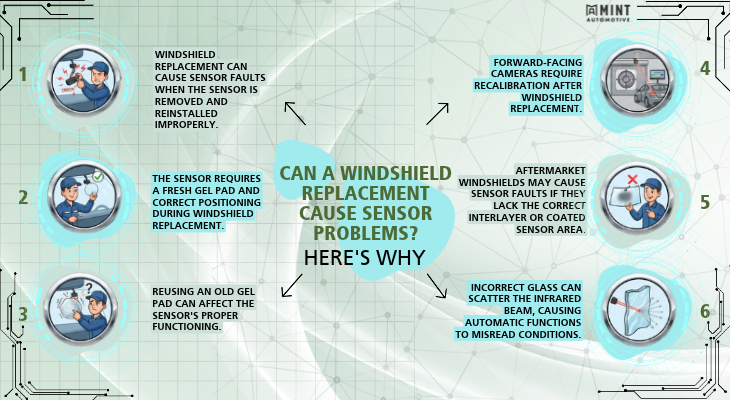
Rock chips are a fact of life on I-5 and the Guide Meridian, and replacement glass is where most of these faults begin. The sensor has to come off the old windshield, receive a fresh gel pad, and go back into the correct bracket at the correct angle, which is three opportunities for a rushed installer to leave you with a feature that never works again. Reuse an old pad and you will certainly lose it.
Worth knowing: on vehicles with a forward-facing camera mounted in the same area, the camera needs recalibrating after glass work regardless of what the sensor is doing.
Aftermarket glass can cause the fault on its own. Factory windshields on these cars carry a specific interlayer and, on some trims, a coated area behind the mirror sized for the sensor to shine through. Cheaper replacement glass without that window scatters the infrared beam, and the automatic functions misread the conditions however well the sensor is bonded.
One housing, more than two jobs
On many Volkswagen models the unit behind the mirror is a combined rain, light and humidity sensor, and the climate control uses that third measurement to decide when to run the air conditioning compressor against a fogging windshield.
That matters here because it changes the symptom list. If your automatic wipers and automatic lights have stopped and the glass is also misting up more than it used to on wet Bellingham mornings, those are not three problems. They are one component that several systems were relying on.
Get the fault read properly
The sensor talks to the car over a data line, so scan data shows whether the module is present, what light level it reports and what rain value it sees when water hits the glass. A sensor reading a constant zero in a downpour has answered the question.
Replacement is straightforward once it is confirmed: a new sensor, a new gel pad, a clean windshield and, on some models, a coding step so the car recognizes it.
Sensitivity settings are worth a mention too, because some Volkswagens let you adjust them from the infotainment menu or the wiper stalk. A setting wound down to minimum behaves almost exactly like a failed sensor in light drizzle, and resetting it has saved more than one owner a repair bill.
Winter Is When This Sensor Matters Most
Driving unlit through a December dusk is not a good look, and manual wipers in heavy spray are a distraction you do not need. We are at 1814 Ellis St in Bellingham, and the full service list is at mintautomotive.com.